
Where to explore in Saigon now?…
Should you coming from somewhere off Saigon, the question above will be simple.
From the Reunification Palace, Notre Dame Cathedral, City Central Post Office, to Thu Thiem Tunnel, Phu My bridge, Cu Chi Tunnel…The “brand new” Saigon offers hundreds sites that will take tourists days to travel and exlore.
However, if you have the same background as I do – an origin Saigonese – who “suffers” everyday at 3/2 Street, drinks Vợt cafe at Phu Nhuan district, or listens to planes landing above Quang Trung Street, then the story is kinda different.
That story is about people who find Saigon desperately boring, whenever they want to hang out.
Before we jump into our journey today, let me introduce myself. I – MOINK20 – is a historical nerd.
I am fascinated by History. But please, not those bullsh*ts you would find in Vietnamese textbooks.
What I’m talking about, is “local history”: family origins, neighborhood’s; history of people, places; history in each sip of tea, or each spoon full of rice. The word-of-mouth legends, not so academic, but interesting enough for a boring day.
Anyway, today, I’m going to show you one of some really “local” stuffs I’ve found in my city: The Hoa’s relics.
FYI: Most Vietnamese articles assume that Hoa people = Chinese. However, to my view, those people had come to Vietnam centuries ago, and played an important role in creating the modern Saigon today, both in economy and culture. They have also been considered one of the 54 ethnic minorities of Vietnam. Thus, I refuse to see Hoa people as Chinese.
Thien Hau temple (pagoda) – Tue Thanh Club
Overall, Saigon is famous with beautiful Buddhist pagodas: Van Hanh monastery, Hoang Phap pagoda, Vinh Nghiem pagoda…However, Hoa people’s Chua Ong (God pagoda) and Chua Ba (Goddess pagoda) are antique attractions that must not be easily ignored.
It was raining when we found a ash-covering wall on Nguyen Trai St. (district 5).

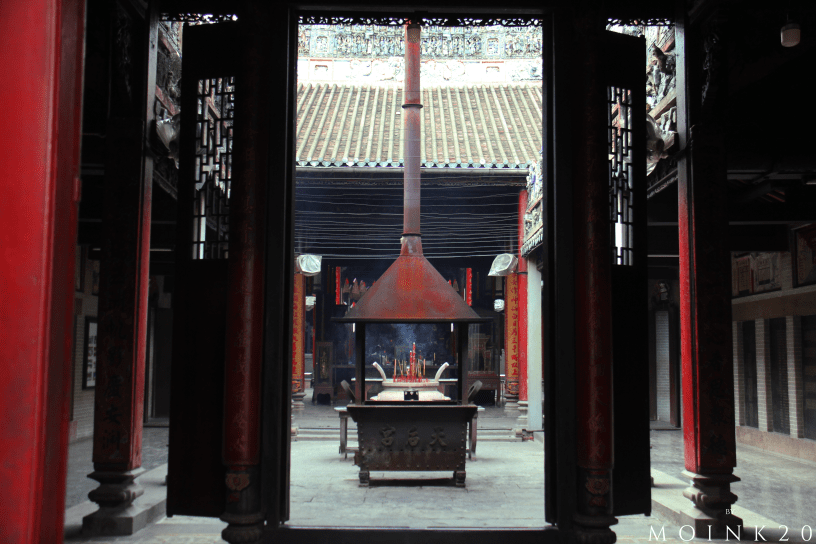
A month before, when heading to Ninh Thuận, I asked my friend if she knew some unique places in Saigon, and Thiên Hậu pagoda was her suggestion. Being a super old piece of my city, with more than 250 years of age, this pagoda is a must-go spot if you really want to explore Saigon.


Ever since, people built the Goddess pagoda to worship Thien Hau, and pray for her protection, should they are about to have a voyage.
When I first came to this pagoda, I instantly felt how old and holy this place was. Everything is “alive”, means that the very antique items are still being used daily, not exhibiting. Without any kind of tourist instruction, anyone who wants to know about this place must either search for information beforehand, or renting a tour guide.

A few pilgrims were praying in their mouths. Some foreigners got lost in their own silence and curiosity. For MOINK20 myself, that ancient breath in each pillar, amulet, incense…were like surronding, which intrigued and thrilled me at the same time. Being an exhausted traveller, I have seen so many half-hearted, “fake” holy auras of the attractions. But that day, Thien Hau pagoda had charmed me with its “real” ritual.


God Temple (pagoda) – Nghia An Club
To make things clear, these “God” and “Goddess” has nothing to do with each other :v
After leaving Thien Hau pagoda, we went to God pagoda, which is 500 metres away.


Hào Sỹ Phường
Some years before, if someone asked me whether I wanted to go to Bitexco Financial Tower or to Hào Sỹ Phường, I would have chosen the Tower. But now my answer is different.
We went to Hào Sỹ Phường at 5pm.


Jade Emperor Pagoda – Phuoc Hai Pagoda
Oops, am I making a mistake here?
Cuz’ this place is really well-known?
Yeah, it does. But still, this is an exception.


Some last words
Overall, tracing the Hoa’s relics can not result in such small amount of answers.
With more than 300 years of history, there must of course be hundreds, maybe thousands of things that I haven’t known yet. That belief of mine is like an adrenaline shot, making me want to “hunt em’ all”.
Khanh Tr.
 moink20.com