
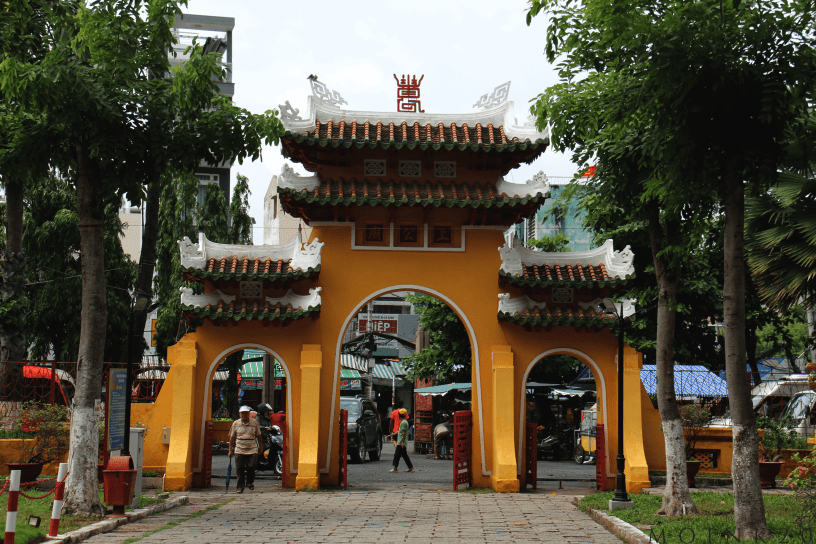
Sai Gon impresses us by its modern look, rather than being an ancient place…
Speaking about “ancient”, I meant “at the beginning of time”, when the emperor and his followers were still longing for news – news about their far land, which had been traded for blood and steel against Khmer, Laos…
Today, many things within our view is from the modern era, not from those days anymore.
Many, but not entirely. And today, I would like to introduce on of the most ancient spots of Saigon.
“Lăng Ông Bà Chiểu” or “Lăng Ông – Bà Chiểu”?
On a sunny August morning, MOINK20 arrived at an old tomb, which has been existed since the regime of Gia Long, Minh Mạng emperors.

Precisely, this place is called “Lăng Ông” (Tomb of the Mandarin), but for its location (next to Bà Chiểu market – one of the first markets appeared in Saigon), the locals have been used to call it “Lăng Ông Bà Chiểu”.
And the Mandarin that we are talking about today, is Lê Văn Duyệt – one of the most famous men in Vietnamese history.
The tale of Lê Văn Duyệt
Back to the old days, when Lord Nguyễn Phúc Ánh (Nguyễn Ánh – later emperor Gia Long) was still struggling against king Quang Trung and the Tây Sơn regime. During one of his run-away, a farmer named Lê Văn Toại was trying to save the Lord. In return, Nguyễn Ánh allowed this farmer’s son – Lê Văn Duyệt – to be the the Lord’s eunich, fighting with him to gain back the country.

Later on, for being an excellent warrior on the battlefields, and a loyal courtier of the Lord, Lê Văn Duyệt became the right hand of the Lord. After gaining back the country, Duyệt continued to served his emperor on protecting the peace. He was then the defense command governor of Gia Định town. Duyệt himself wiped out the rebels, built Phiên An town (today’s Saigon) into a bagua stronghold.

However, when Gia Long’s second child became the next emperor (Minh Mạng emperor), the relationship between our Mandarin and the new king was full of conflicts. Part of the reason was that Duyệt wanted the first child (who passed away when he was 21 years old) to be the next emperor. Another explanation was for Duyệt’s hot-tempered attitude, which caused lots of annoyance for the new king.

The rebel of Lê Văn Khôi

Being a natural homosexual, plus emasculated to be a eunich, Lê Văn Duyệt did not have any child. Instead, he adopted many, and one of his godchildren is a bandit in northern Vietnam, named Lê Văn Khôi.
After Duyệt passed away, emperor Minh Mạng began to increase his influence on Gia Định town, by dividing the old government model of Duyệt, and massacred many closed relatives of his.
Lê Văn Khôi knew this beforehand, and had gathered an army for rebellion. They had the power and surprise element, and had therefore crushed the dynasty’s system in the Southern Vietnam.
Later, however, the rebel was defeated; Lê Văn Khôi died because of disease in Phiên An stronghold. The other leaders were dissected to death. Lê Văn Duyệt, for being the (god)father of Khôi, received 6 death sentences. But since he had already passed away, his tomb was then chained. Had it not been for emperor Thiệu Trị and later Tự Đức, Duyệt’s tomb could have been chained forever.
Lăng Ông nowadays

Lăng Ông was newly built in 1948 and reconditioned throughout the decades. Thus, the very ancient features can still be observed, from the gates to all the ceilings inside.


Endings
You may feel bored, for this blog is pretty historical related right?
But back in the old times, I used to receive no information from people around me, whenever there were anything that looked old and dusty in my city.
For that reason, this is my privilege to give all the information for those who concerns. Getting to know about Saigon and still, having no notice about Lăng Ông? I would consider that a big gap.

Khanh Tr.
 moink20.com