
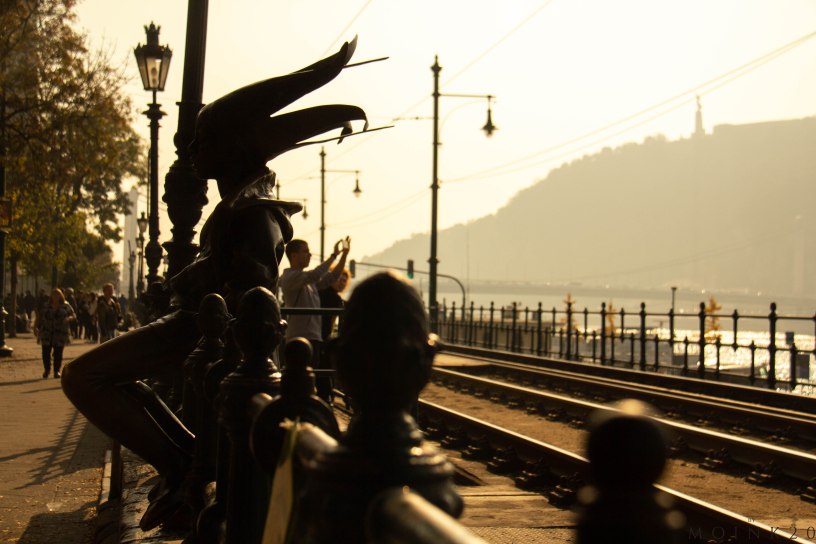
Budapest is the last stop in my trip, and indeed a perfect stop; it has been beautiful sad, being here.
Saying goodbye to K., I continued on my lone trip, which has been more than one week,, through 4 countries. This time, Flixbus would take me from the glittering Wien to another by Danube-city, Budapest.

From the cool, chilling sun of Wien, I came down from the bus to feel the humid air spoiling the air – First time ever since August 2018.

It felt like being in some old movies with weird starts, with an Asian guy, wearing jacket, came down from an old bus and start sweating in the middle of nowhere. My phone 4G didn’t work; neither was my pocket money – It is Hungarian Forint (HUF) the main currency here. This was the second time I came up with the currency issue when traveling in Europe.
But anyway, finding a way has never been a problem for me. I eventually found out how to get to the city center using metro, and here my credit card was accepted.
The metro, how to say, looks similar to those in Wien. The fact that Austria-Hungry used to be one big empire helped to explain this. However, if the Austrians are known to be the “richer half”, then Hungarians are sadly the poorer ones.
The city vibe
For me, the overall feeling during my short stay in Budapest had been priceless: I cherished every moment breathing its air, walking its avenues, and allowing the bitterness of Hungarian history to swallow and flow me far away. Being alone in such city, you can listen at the most sincerity.
Living in Budapest brings you back to decades ago. Most of the buildings are old-built, goods are affordable, not too much tourists, and the living pace was quite slow and steady. And, do you know that Budapest has the oldest metro line in continent Europe that is still functioning?

At night, you can feel the city is living – unlike many other European cities. Evening street foods are just around the corner; jazz clubs, bars and cafes are up until midnight and more. If you happen to be at the Jewish Ruin Bars area, there’s a high chance you can get to know the most about this city’s personality: it comes back to life when the light’s gone.

Going further to the harbor area, you will find another face of Budapest: the sweet bitterness.
Why I thought about it this way? Because it looks so beautiful, with a sad history.

On the boat trip that night, we were sitting on deck. The boat was steadily floating across the river banks. In contrast to the daytime, Danube became freezing cold when nights come. One hour, and the brief history of the city was revealed – the story of one city that is cut to exactly two halves by the Danube.


If you would later walk across the river bank to the Parliament House, there will be a memorial in form of 60 pairs of shoes. This is the memorial of the Jewish victims, who were executed and fell down to the Danube in WWII. It was a total depressing feeling for me when walking through this part, looking at each pair, some standing straight, some falling to all kinds of position. There is no word to describe how horror it must have been to witness the real happening, more than 70 years ago – even until now it keeps giving me goosebumps. Every city has a history, and Budapest’s is perhaps one of the most haunting ones for me.

And if you already know how hard life can be to be living under fascism or communist regime, can you imagine how it must have been for the Hungarians, when they literally lived under these two regimes consecutively?

Another highlight of Budapest, no surprising, exposes the dark side of their history – the House of Terror. Coming from a Communist state – Vietnam, I know both the good and bad side of this political system. But this is the first time I ever visited a Communist crime museum, where used to be the HQ of them in Hungary, and is recommended as a “must-go” when coming to Budapest.
I was not allowed to take any picture, and the entrance fee was quite costly. But the experience is completely worth it, if you are interested in this aspect. A very dark chapter of Hungarian history indeed.
The Hungarians
What happened in the past shapes who we are today. Being through many major losses, Hungarians are known to be unfriendly and rather pessimistic; for instance, they will go to a party and say “this party is half-empty” instead of “this party is half-full”.
In metros, there are no automatic machines – there will be people checking your tickets, very often, usually no English, and no friendliness. However, in restaurants, the Hungarians are quite hospitable, and most of them are learning German, as the majority of tourists are Austrians and Germans.

Also, Hungarian language is known to be the third most difficult language in the world – after Mandarin Chinese and Russian. The closest language to them is, surprisingly, Finnish (I have to be honest that I found absolutely NOTHING similar when acquainting with Hungarian).
Ending

Being a historical-geek, I totally understand if my readers, who have been to Budapest, would disagree with my review. Budapest is indeed a festive tourist city with good and affordable food and drinks, thermal baths, parties, and stunning views.
For me, the city itself is growing, further and further away from its dark past, toward a brighter future. I just felt in love with the hidden scars that help to remind people not to forget what had happened, thus not letting it occurs again.

To be continued…
Khanh Tr.
 moink20.com